 Swiss Economicblogs.org

An executive order issued on January 23, 2025, aims at protecting “Americans from the risks of Central Bank Digital Currencies (CBDCs), which threaten the stability of the financial system, individual privacy, and the sovereignty of the United States, including by prohibiting the establishment, issuance, circulation, and use of a CBDC within the jurisdiction of the United States.” The executive order defines CBDC as “a form of digital money or monetary value, denominated in the national...
Read More »“Report by the Parliamentary Investigation Committee on the Conduct of the Authorities in the Context of the Emergency Takeover of Credit Suisse”
The report (in German). From the press release: The Parliamentary Investigation Committee (PInC) attributes the Credit Suisse crisis to years of mismanagement at the bank. It is critical of FINMA’s relaxation of capital requirements and regrets the lack of effectiveness of its banking supervision. The PInC also criticises the hesitant development of the TBTF legislation and identifies shortcomings in the flow of information between authorities. It does not find any misconduct on the part...
Read More »“Governments are bigger than ever. They are also more useless”
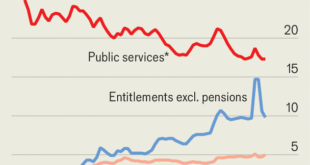
Says The Economist. The authors argue that falling state capacity, incompetence, corruption, and transfer/entitlement spending, which crowds out public investment and services, are to blame. Update: Related, in VoxEU, Martin Larch and Wouter van der Wielen argue that [g]overnments lamenting a stifling effect of fiscal rules on public investment are often those that have a poor compliance record and, as a result, high debt. They tend to deviate from rules not to increase public investment...
Read More »The New Keynesian Model and Reality
To analyze the transmission from interest rate policies to output and inflation, many academics and central bank economists use the basic New Keynesian (NK) ‘three-equation model’ and its various extensions. A key factor responsible for the model’s success is the seeming alignment with conventional wisdom—some of the model features can be framed in the language of familiar business cycle narratives, as found in newspapers, central bank communication, or introductory macroeconomics...
Read More »Urban Roadway in America: Land Value
In a CEPR discussion paper, Erick Guerra, Gilles Duranton, and Xinyu Ma estimate the cost of land use for roads in the U.S.
Read More »A Financial System Built on Bail-Outs?
In a Wall Street Journal opinion piece and an accompanying paper and blog post, John Cochrane and Amit Seru argue that vested interests prevent change towards a simpler, better-working financial system. They describe various “bail-outs” since 2020, in the U.S. financial sector and elsewhere. They point out that in Switzerland, too, the government orchestrated takeover of Credit Suisse by UBS relied on taxpayer support. And they conclude that regulatory measures after the great financial...
Read More »Budgetary Effects of Ageing and Climate Policies in Switzerland
A report by the Federal Finance Administration anticipates lower net revenues for all levels of government. … demographic-related expenditure will increase from 17.2% of gross domestic product (GDP) to 19.8% of GDP by 2060. If no reforms are made, public debt would rise from the current 27% to 48% of GDP. The need for reform is particularly pronounced at federal (including social security) and cantonal level. While AHV expenditure in particular poses a challenge for the Confederation,...
Read More »SNB Annual Report
The SNB has published its annual report. Some highlights from the summary: Climate risks and adjustments to climate policy can trigger or amplify market fluctuations and influence the attractiveness of investments. From an investment perspective, such risks are essentially no different from other financial risks. The SNB manages the risks to its investments by means of its diversification strategy. … A prerequisite for illiquid assets to be used as collateral in obtaining liquidity...
Read More »Banks and Privacy, U.S. vs Canada
JP Koning writes: An interesting side point here is that Canadians don’t forfeit their privacy rights by giving up their personal information to third-parties, like banks. We have a reasonable expectation of privacy with respect to the information we give to our bank, and thus our bank account information is afforded a degree of protection under Section 8 of the Charter. My American readers may find this latter feature odd, given that U.S. law stipulates the opposite, that Americans...
Read More »Bank of England CBDC Academic Advisory Group
The Bank of England and HM Treasury have formed a CBDC Academic Advisory Group (AAG). The AAG will bring together a diverse, multi-disciplinary group of experts to encourage academic research, debate and promote discussion on a range of topics, to support the Bank and HM Treasury’s work during the design phase of a digital pound. Members: Alexander Edmund Voorhoeve Professor of Philosophy London School of Economics Alistair Milne Professor of Financial Economics Loughborough University...
Read More »